Introduction: The (Inter)Actions in Public Space
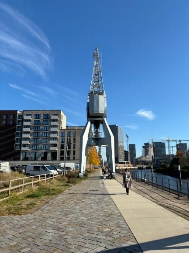
While walking through HafenCity, an old trade district that is being repopulated through a redevelopment in Hamburg, I noticed industrial cranes standing on the boulevard, unused but still playing a part in the surrounding environment. The visibility and history of this specific place stay noticeable. While cycling through Zwolle I noticed several local power transformer boxes, which are also structures in public space that can be found in every part of the city. Urban infrastructure like this makes me think about their potential, like how they could promote interactions between humans and non-humans. I fantasise about reusing neglected infrastructure in public spaces in a way that adds new roles to their functions and public identity. In my mind, I associate these common urban structures with plants — much like weeds, they are often underused, unwanted and overlooked,but noticeable and scattered throughout the city.
When I cycle to school, I interact with cars that pass me by, leaves on the road below me and other things I pass like bus stops or traffic lights as I move through public space. This makes me wonder about all the possible interactions between humans and non-humans that occur in public space.
At the International Architecture Biennale Rotterdam (IABR), in 2024, the IABR-Transition Atelier Jeux des Joules1, a design and research team, explored new strategies for local power transformer boxes, whichsometime seem out of place in the urban environment.
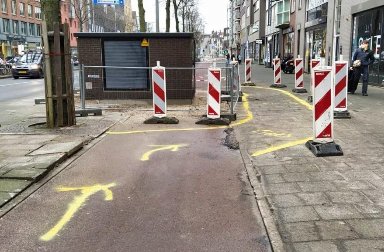
Imagine cycling through Amsterdam and encountering a power transformer box on the road. The design and research team, The IABR-Transition Atelier, stated: “Public space is like a river. Everything inside it will be shaped by the constant flow of people, vehicles, materials and animals that runs through it.”2 Using a river to describe public space speaks to me because it implies that public space is always moving and dynamic. The IABR-Transition Atelier wondered, “Can we integrate other urban functions into these small buildings?”3 Adding another importance to the role of power transformer boxes can lead to interaction between human and non-human actors.
The eco-philosopher and anthropologist, Bruno Latour, sees humans and non-humans; as actors and participants in a society who both have influence and make effect change. Non-humans – such as this laptop, my glassesor my desk chair- are not just passive objects; they play an active part in what I can and cannot do. Without the laptop, I wouldn’t be able to add this sentence between two others to exemplify the influence of non-humans – I would have to rewrite the text by hand. The rain might be the reason you take the bus instead of your bike. The speed bump on the road slows down the bus, which affects the time of arrival at the next bus stop without human interference. A laptop, glasses, a desk chair, the rain or a speed bump all make something possible, influence human actions.
You might say that the wheels of a car are all the same. Yet each wheel has a different influence on the balance and steerability of the car. Imagine a society without objects, artefacts or animals (non-humans). It leaves little besides us humans. So, the share of non-humans in networks must also be valued equally. Non-humans should not be seen as passive but as active. Imagine a classroom without students, or with students, but without tables and chairs. In both cases, there is a network of relationality. But the relationships between actors, in this case the students, tables and chairs located in the classroom change. When there are no tables and chairs in the classroom, students might start occupying space differently, which might create different relationships between students and between the students and the classroom. Both students and tables have an influence on the classroom.
Networks between humans and non-humans also exist in public space: people feeding stale bread to ducks, in their local park; or imagine standing on the shore, but without any seagulls that usually fly rakishly over your head. Think of a bench near the train station that people often sit on to kill some time. These examples all describe a relationship between humans and non-humans in public space. But the share of non-humans in these cases is often not considered, let alone valued.
Sometimes I wonder, do we take the presence of non-humans in public space for granted? I have often thought about whether municipal infrastructures influence the relations between humans and non-humans. I am curious if and how a bench influences the ducks in a pond, or if an overflowing trash can address environmental issues in a neighbourhood.
I think of the world as a big web of elastics — the coronavirus radically shifted our sense of reality. Relationships soon appeared between the coronavirus and vaccines, facemasks, and apps on your phone. This could be understood through a concept like elasticity, elastics stretched between the increasing number of people working from home and changes in spatial organisation, in offices and public spaces. The relationships between themwere dynamically shifting. Events like this support Bruno Latour’s theory. Bruno Latour uses Actor-network theory to encourage ecological thinking, by recognising and promoting interwovenness. Like people, objects, artefacts, animals, plants and weather influences also play a part in social problems. You cannot separate the nitrogen crisis from the climate crisis, the agricultural sector, for instance, or the factories emitting a lot of carbon-dioxide. There are many more connections, not only manure or the cars we drive.
Rob Roggema4, professor of Regenerative Culture writes about how urban landscapes can be designed more ecologically: “The Eco-cathedric City builds on the self-organizing power that is common in nature. This fundamental new way of urbanization applies power to three factors: the time perspective of urban change (eco-time), the way the city is designed (eco-space), and how decision making occurs (eco-cracy).”5 These three factors offer a different perspective on how to build cities that are not just about humans. Because humans are not the only participants in the city or ecosystems around us.
Oppositional Relationships: Humans and Non-Humans in Public Space
Treating non-humans as non-participants has greatly affected how designers approach the world. The current separation between humans and non-humans is unjust to both parties, including endangered species, melting icebergs, and people who lose their homes due to natural disasters. The climate crisis and the nitrogen crisis affect both humans and non-humans. The word crisis understates the seriousness of the current situation, especially when we consider the impact of humanity on the earth. We know a crisis to be temporary, something that will pass.
But global warming, rising water levels and worrying CO2 levels are irreversible. The Parliament of Things6 by Bruno Latour makes a case for the rights and voices of non-humans, like animals and objects. With this paper, I align myself with this aspiration, to give a voice to the non-humans in the public space, which we see, meet and use on a daily basis.
How can municipal infrastructure promote the relationship between humans and non-humans in public space?
Aims and Intentions
This paper investigates the possibilities of municipal infrastructure, like trash cans or bike racks, and their role in public space in relation to design for non-humans. And how their functions or public identities can promote the relationship between humans and non-humans in public space. A bike rack could also store rainwater and function as a bird feeder. Non-humans in public space are often not taken into consideration, and the rapid building of cities possibly destroys local ecosystems consisting of humans and non-humans, like an old tree in a vacant lot, worms in the soil, or swallows living in the old roof of the building that needs to make space for new development.
In this paper, non-humans are co-actors in the environment, which means that they actively influence or affect public space, like cats, squirrels, earthworms, moss, poison ivy, bodies of water, traffic signs or parked bikes.Non-humans can be more than animals, insects, plants, environmental features or objects; they can be bacteria or wind, but this research focuses on tangible non-humans. In this paper, the relational and functional aspectsof non-humans are most important. Including relations such as: squirrel-human, squirrel-plant and squirrel-infrastructure. People sometimes feed squirrels, and squirrels spread seeds (of acorns). Trees and the edges of buildings are used as pathways by squirrels. Or the functions of bodies of water: can support biodiversity, shape the public aesthetic of a place or recharge groundwater.
My research is centred on giving municipal infrastructure a voice, and does so by creating new possibilities and designing use cases. What if underused, overlooked municipal infrastructure in public spaces would be reused, or a new role like ‘interferer’ or ‘participator’ could be added to the public identity of a power transformer box or a bottle bank? Or if urban infrastructure encourages humans and non-humans to cooperate?
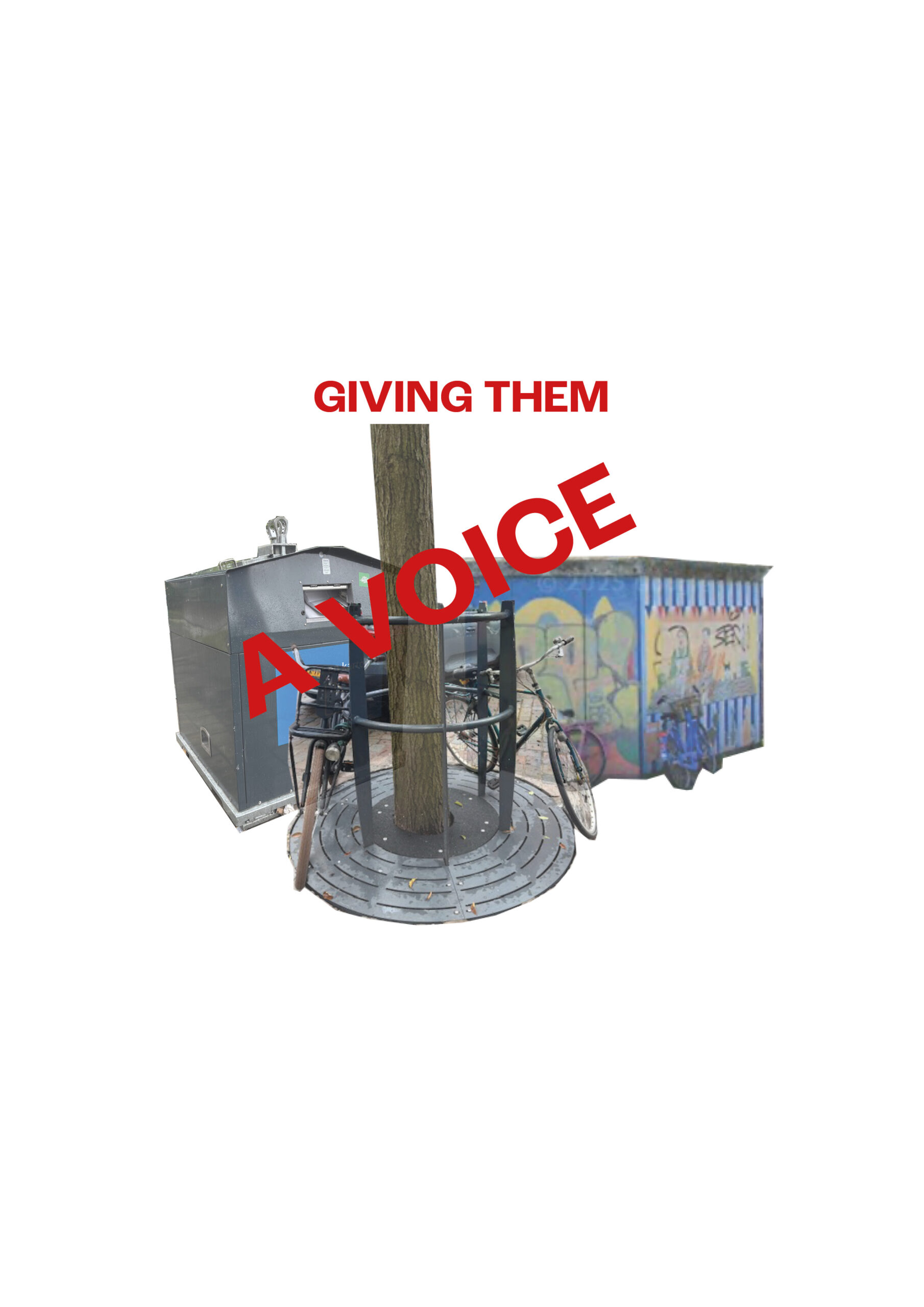
While researching this topic, I made the connection between overlooked urban infrastructure in public spaces to weeds. Weeds grow in places we don’t want them due to specific local circumstances. Sometimes, they thrive even though humans wish them to be gone, to perish. I wonder what would happen if we considered certain infrastructures as weeds. How can certain municipal infrastructures be understood as Architectural Weeds? Can a municipal infrastructure be influenced by specific local circumstances and grow?
A framework that defines the relationship between humans and non-humans, as Architectural Weeds opens up questions of how certain municipal infrastructures might encourage the public to participate in ecosystems or adopt a more ecological attitude towards their environment. This paper aims to promote and support the relation(ship) between humans and non-humans in public space, by introducing the notion of Architectural Weeds and Architectural Weeding as a new design principle. This research looks at the design of certain municipal infrastructures, and what they do or possibly don’t do for the non-human and speculatively proposes how these designs could change to be more habitable. This paper proposes a new design principle, Architectural Weeding, that promotes and supports the well-being of non-humans in public spaces and creates new possibilities and use cases.
Research Questions
How can municipal infrastructure promote the relationship between humans and non-humans in public spaces?
Sub-questions:
- Can new purposes for municipal infrastructures be developed through design?
- How can municipal infrastructures be designed to promote the well-being of non-humans, as well as humans?
- How can the design of municipal infrastructures address climate and environmental issues at a neighbourhood level?
- How can the notion of Architectural Weeding as a design principle support/encourage new relationships between humans and non-humans to thrive in public space?
Methodologies
Oppositional Relationships between Human and Non-human
To investigate the research questions, I use a combination of literature review, mapping, situational analysis, field research, and design intervention. First, a literature review of several sources is done to establish a foundation. The main sources this research reviews are “The Eco-Cathedric City: Rethinking the Human–Nature Relation in Urbanism” by Rob Roggema, professor of Regenerative Culture and multiple sources by eco-philosopher and anthropologist Bruno Latour, such as Facing Gaia: Eight Lectures on the New Climatic Regime. The discussion is centred around the Actor-network theory and The Parliament of Things by Bruno Latour.The study, below reviews articles and essays that discuss the Ecocathedral by Louis le Roy. Through this review, the research studies the current relationship between humans and non-humans and addresses the urgency behind this research through an analysis of everyday situations.
A New Understanding of Municipal Infrastructures
In Chapter 1: Cooperating With the (Non-) Human World, a new term is introduced to define municipal infrastructures as an architectural typology: Architectural Weeds. By observation and analysis of municipal infrastructures in public spaces, I have been in myself the term: Architectural Weeds has been developed. Comparisons with weeds are used to solidify the term and illustrate the definition. Architectural Weeds are defined,explained using a list of criteria, and descriptions of examples such as power transformer boxes or trash cans and several formulated typologies.
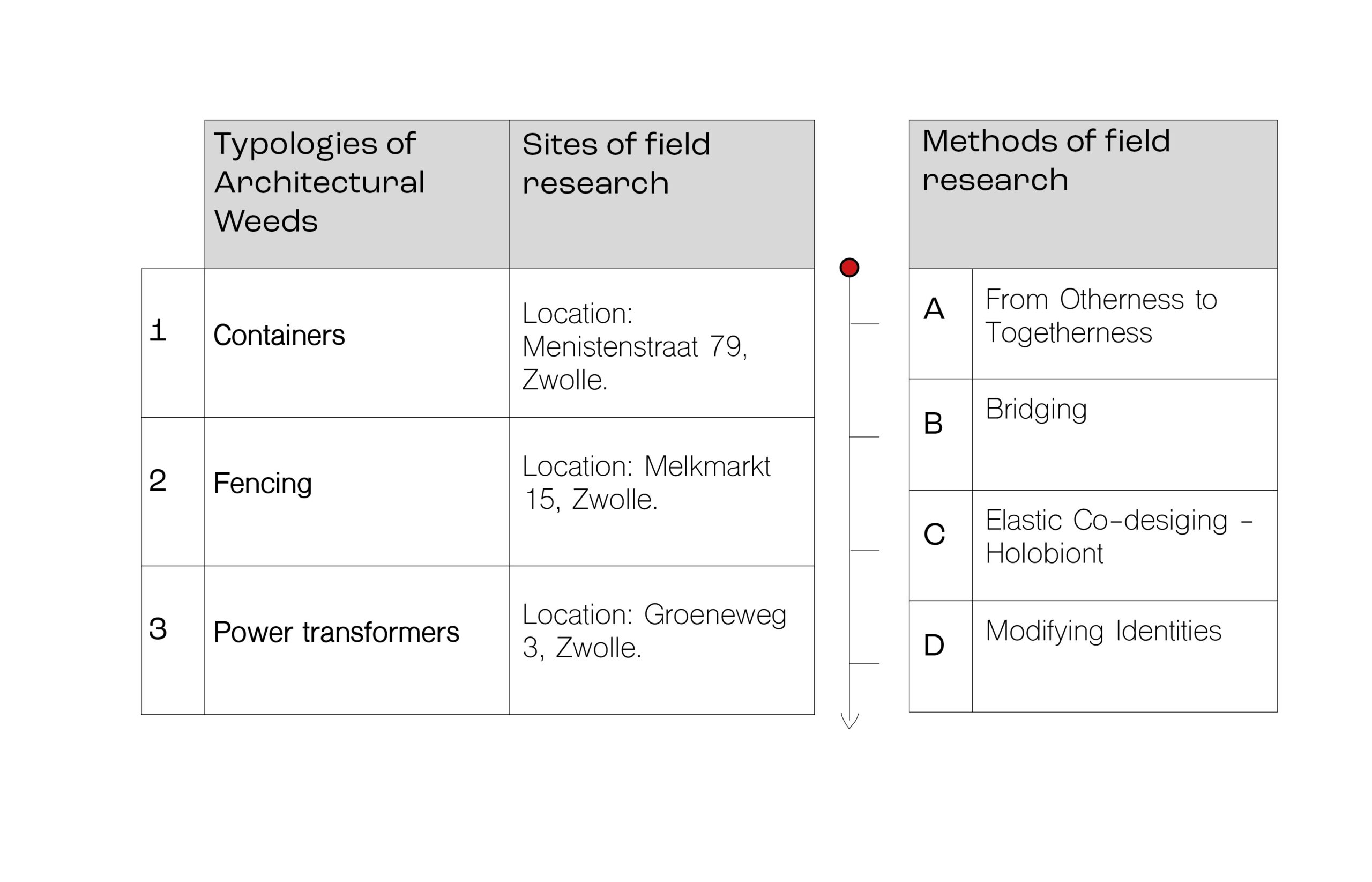
In Chapter 2: Into the Field, field research methods/techniques are developed through literature research concerning non-humans in public space and the design of urban municipal infrastructures. These methods/techniques are used to observe, analyse and map sites of municipal infrastructures. The relationships between humans and non-humans in the public spaces of the city of Zwolle are described and questioned. The research focuses on three specific typologies of municipal infrastructures (Architectural Weeds) in public spaces: containers, fencing and power transformers. For each typology, one location/site is selected. Three separate sites of municipal infrastructures are examined and researched to document their differences and similarities.
The newly developed research methods are explained in a concise way using scores with several steps, describing how to execute the research.7 Four methods/scores together form the field research process, which aims for municipal infrastructure to become more habitable and promote, support the well-being of non-humans in public space. My research is also about developing use cases, which others can utilise, so the development of these methods is also part of this research.
Method A: From Otherness to Togetherness, focuses on inventorying the site, mapping the present (non-)humans and questioning their boundaries, relationships.
Method B: Bridging focuses on the functional and relational aspects of a specific piece of municipal infrastructure and how this infrastructure can function as a bridge between the (non-)humans located at that site.
Method C: Elastic Co-designing – Holobiont targets several what-if scenarios that aim for cohabitation, coexistence between (non-)humans.
Method D: Modifying Identities targets the design aspects of municipal infrastructures and how new roles can be added to their public identities through design.
The four methods above consist of various ways of analysis/research, such as field notes, schematic drawings, floor plans, maps, photographic documentation, and written observational logs. All four methods question existing factors of certain municipal infrastructures.
The study aims to develop a new way to describe certain municipal infrastructures and their functions, identities, by considering both human and non-human aspects of these infrastructures, resulting in a glossary with clear terminology.
An inquiry into the regulations behind certain municipal infrastructures in Zwolle provides information on how archetypes of municipal infrastructures are developed and why repetition of the same infrastructure is the norm. Motivations behind the standardisation of certain infrastructural designs are considered, while the focus of this study is on specific municipal infrastructures: containers, fencing and power transformers within the city of Zwolle.
Research into designers who consider non-humans as co-actors in the environment provides new insights into how to listen to, work with non-humans in public spaces.
New Roles of Municipal Infrastructures
In Chapter 3: A New Design Principle, Architectural Weeding as a new design principle is proposed. This design principle promotes and supports the well-being of non-humans in public spaces. The application of the four methods resulted in key elements of Architectural Weeding as a new design principle. The shift from thinking of municipal infrastructures as Architectural Weeds to acting and starting to weed is made and explained.Ecological perspectives are transgressed towards municipal infrastructure; characteristics of plants like rhizomes and roots are used to imagine a different way of designing and using municipal infrastructures. New possibilities of design and use cases of Architectural Weeding are described.
At the end of this paper, Habitable Futures are proposed, the design principle, Architectural Weeding, is presented, and conclusions on how municipal infrastructure can become more habitable for non-humans and support thriving relationships between humans and non-humans in public spaces are made.
Chapter 1: Cooperating With the (Non-) Human World
The World as a Web of Elastics
Bruno Latour problematises the distinction between nature and culture and recognises that non-humans possess a capacity to trade besides humans. Rob Roggema8 writes about the design of ecological urban landscapes, the principles of deep ecology, and how humans have no right to dominate.
Thinking in the opposite direction of opposing and distinguishing between humans and non-humans could be beneficial. As well as ‘working with’ rather than against or separately. Public space is important in building cities that are not just about humans. We (humans) are part of ecosystems, as are objects, animals and urban infrastructure like trash cans, power transformer boxes and tree guards.
The voices, opinions and interests we pay attention to are often human. The Parliament of Things9 by Bruno Latour makes a case for the rights and voices of objects. Rather than being abstract, politics becomes more tangible when all the voices of those involved are heard. What would a lamppost in Brooklyn, New York, say? What’s a typical day for a lamppost? In Everything is Alive10, objects are interviewed, and they tell us about their lives. “Everything is Alive is an interview show in which all the subjects are inanimate objects. In each episode, a different thing tells us its life story – and everything it says is true.”11 Maeve the lamppost sees when people are balding and thinks of herself as a steady presence. She is pretty tall and also a holder of notices. Her workday starts at 7 am usually.12 By looking for objects that are willing to speak, and interviewing them, an ordinary, everyday object becomes something to think about as an important actor.
Through the research of The Parliament of Things, The Embassy of the North Sea was founded to address the insufficient representation of non-humans amidst the current ecological issues. The Embassy of the North Sea “listens to and involves the voices of plants, animals, microbes, and people in and around the North Sea.
Founded on the principle that the sea owns itself, the Embassy makes political space for sea-emancipation through connection, imagination and representation.”13 To pursue a deeper understanding of the ‘Rights of Nature’ and demand attention for the ecosystemic rights, the Confluence of European Water Bodies was formed14. A community of ecologists, artists, activists, and lawyers representing bodies of water like seas, lakes and rivers from all over Europe.
“The Diplomatic Suitcase is the symbolic, mobile, and tangible representation of the Confluence of European Water Bodies. It is literally a suitcase that unpacks into an exhibition showing the identities of the participating water bodies. This multimedia and portable installation tells stories of the many problems European waters are facing, from contamination by agriculture to dam constructions, but also demonstrates how water diplomacy can give rise to an emerging alliance of water.”15
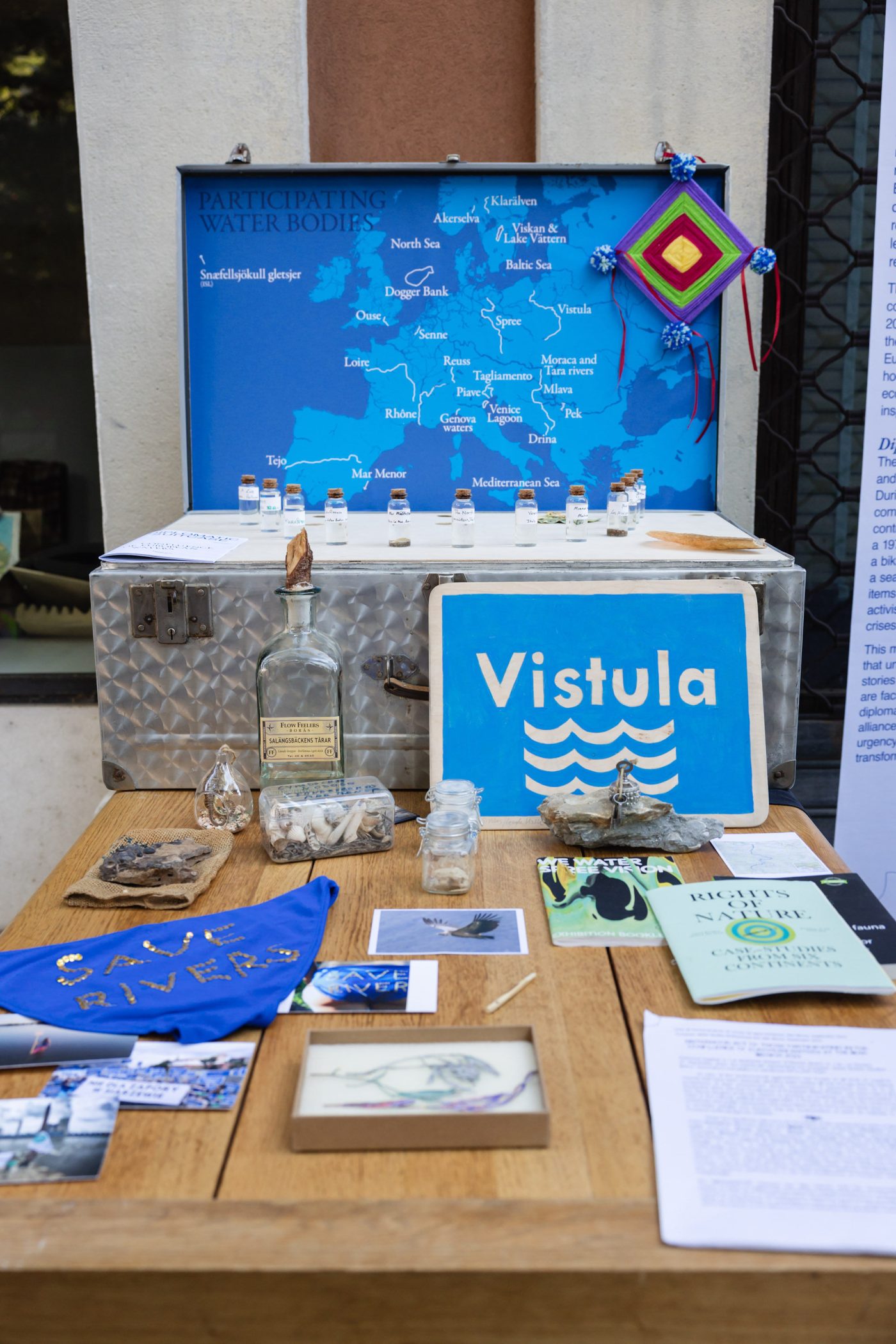
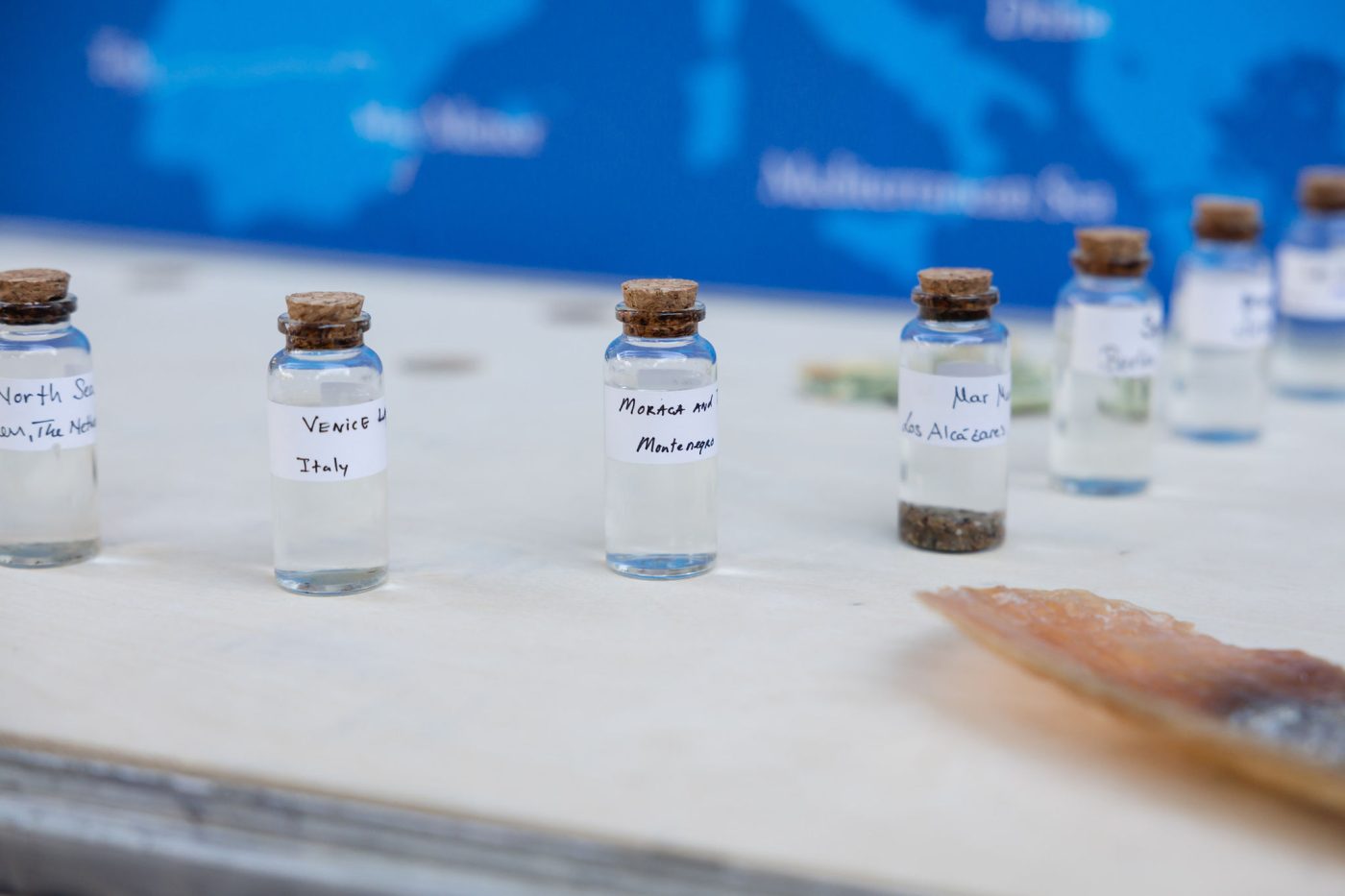
‘Ecosystem services’ often reflect a human-centric view, seen as ‘the services an ecosystem provides to humans’. Whereas, eco-socially, we are part of these ecosystems. Thinking in opposition and abstraction have left us disconnected from this reality.16 To change this, the design research collective Sea -place -work -land breaks the bureaucratic order and started the Eco-social Affairs Agency. “You have been called to the Ecosystem Service Duty! We must learn to see, feel and be in relation to the lives of others.”17 Together with human and non-human Delta Workers such as seaweed, fishermen, mussels and dyke workers, they work on ‘eco-empathic action research’. Because designing landscapes means working with the (non-)humans and other elements that make them up.
But how can this cooperation between humans and non-humans be shaped? “Architecture is Climate is a project that reimagines the future of architecture through exploring its entanglement with climate breakdown.”18Ontheir website, different prompts for futures are displayed which propose new ways of thinking and acting to achieve climate justice. “Neither a definitive list nor a set of instructions, the prompts are catalysts for rethinking relationships such as those between labour and economy, resources and policy, or infrastructures and culture.”19 Perhaps these prompts can be used as catalysts for rethinking the relationships between humans and non-humans, or humans and municipal infrastructures.
The prompts show how social and spatial practices can be envisioned. For example, “Plan beyond building – because there are so many other ways of doing architecture”20 New spatial formations caused by climate breakdown often are as much about process as form. Social and environmental relations are changing with the climate. These changing relations require new skills that go beyond common perceptions of architecture. These include co-defining problems, reimagining work, organising spatial relationships, and caring. Continue to rethink these formations and relationships as forms of collective (spatial) agency that extend beyond the building21.Louis le Roy, the originator of the Ecocathedral in Mildam, also thought of architecture as a process, which is explained in the following paragraphs. By rethinking the spatial relationships between municipal infrastructures and humans in public space, plans can emerge that are not just about building but about processes and actions.
The Ecocathedral
Roggema explains the term Ecocracy in the article “The Eco-Cathedric City: Rethinking the Human–Nature Relation in Urbanism”: “Ecocracy as a governance system reflects the principles of deep ecology: the idea that humans and the environment are of equal value and for that reason humans have no right to dominate nature. Making decisions about the urban landscape, therefore requires a broader variety of participants.”22 This way of thinking in equal values gives voices to all participants of ecosystems, like plants, objects and weather influences. The impulse for “The Eco-Cathedric City” came from the Ecocathedral in Mildam, which is an ongoing complex process that requires both contributions from man and nature, ‘eco’ stands for nature and ‘cathedral’ for culture.
In the article “Time-based Architecture in Mildam. De Ecocathedraal (Ca. 1970-3000) Van Louis Le Roy”, Piet Vollaard writes about how the distinction between culture and nature has disappeared in this process: “As an ecological system, the Ecocathedral is artificial in that it is devised and maintained by man. Without its creator piling up stones, it would simply not exist. At least not in its present state or without the accident of nature.”23
Maybe we must think of ourselves as ‘ecotects’ instead of architects. Louis le Roy (1924 – 2012) was a Dutch artist and writer who called himself ‘ecotect’ and is the originator of the Ecocathedral. This structure emerges as the product of lifelong and endless cooperation between humans, plants and animals.
Instead of short-term thinking, the Ecocathedral is about cathedral thinking. The building of catherdrals often extended over several centuries. Le Roy used long-term thinking to ensure that his project is also of value for next generations. The Ecocathedral is a generative process that started in 1965 and is set to continue (at least) until the year 3000. It is impossible to predict how the process will unfold. At the time, Le Roy said that the science of complexity is so new that no one really knows exactly where its limits lie and how we can define it. “If I say to a politician: I strive for complexity, he will say: would you mind drawing that for me? That is impossible.”24 There was and still is no desired or definitive end result for the Ecocathedral; there’s only a process that continues, the design is open-ended.
Urban Ecosystems
Le Roy has made the distinction between nature and culture disappear in the ecocathedral process. The relationship between humans and non-humans increases through this process, with people piling up stones and plants growing in between them, and birds searching for insects.
The design research collective Sea -place -work -land adds to this; designing landscapes means working with the (non) humans and other elements that make them up. What does public space consist of? Urban infrastructure, roads, city squares, outside air, people, animals, plants, public space is where we as humans move amongst others like birds, breezes and cars. Linking back to the statement of the IABR-Transition Atelier,“Public space is like a river. Everything inside it will be shaped by the constant flow of people, vehicles, materials and animals that runs through it.”25 So this could imply that municipal infrastructure such as benches, tree guards and power transformer boxes is also shaped by the flow of the moving actors in public space. Perhaps I can direct this flow with the research I’m conducting in this paper.
Pigeons in the city centre have a relationship with specific restaurants that serve food, of which they might like to eat the leftover crumbs. Pigeons also relate themselves to lampposts, to rest on, and have a look around. They are a part of the urban ecosystem that keeps on changing depending on the flow of the moving actors in public space.
“Can we build structures to house urban pigeons?”26 Arne Hendriks wonders in his project, where he builds pigeon towers with mycelium. In collaboration with Mediamatic, Hendriks explores the possibilities of mycelium as a building material and how we can coexist in urban environments. The question “How can we humans be better actors in the world we dwell in?”27 is core to the research on building Mycelium-Waste-Pigeon-Towers. This relates to the sub-questions of this paper, promoting the well-being of non-humans and humans, and encouraging new relationships between humans and non-humans.
Arne Hendriks describes on his website how a pigeon tower is a constantly changing process; the moment you encounter it decides what you call it. “By its very essence it is in a constant process of one state moving into another. It is a holobiont, a cooperation between species, technology, nature and time. Something that weaves animal, plant, fungi, technology and humanity, as well as various domesticated and rewilded variants of these, into one living and dying system. There is no start, there is no finish, only periods of rest, frantic activity, and transformation.”28 The process, open-ended thinking relates to the Ecocathedral of Louis le Roy.
The term holobiont stands out to me, fusing or weaving different actors in a built structure that doesn’t have a final form or stage. The concept of a holobiont refers to an entity that is shaped by the association of various species uniting together in a group of interconnections. When a non-human, like a butterfly or a cactus, lives in symbiosis with the microorganisms it hosts (symbionts), it is a holobiont. 29 A pigeon tower is a holobiont because the mycelium allows pigeons to build nests inside the tower. Coexistence in urban landscapes is made possible within an open-ended process.
When building cities that are not just about humans, common public places can be reimagined. Take a playground; the only actors that are taken into consideration while designing this playground are humans. But what if playgrounds are designed for non-humans? Non-human inhabitation is shown in the exhibition: A playground for Non-Humans30 by the Architectural Association School of Architecture in London in partnership with Japan House London. In this exhibition, architectural installations designed for dogs were displayed in several public spaces.
The one-minute city is “the space outside your front door, the street your block or house sits on – but more importantly, it’s the invisible fabric the relationships you have with that environment and in that environment.”31Outside my front door, there are plenty of non-humans to mention: neighbourhood cats, different types of containers, a hydrangea plant, brown bricks, and a doormat. If you think about your front door and the space outside, what non-humans come to mind?
Architectural Weeds
Benches, bike racks, bottle banks or power transformer boxes don’t have a fixed place like a traffic light or a lamp post. They can be moved to a certain degree and still have relations with other actors, like buildings, a bike path or a train station. In the introduction, I wrote about how urban infrastructures are often underused, unwanted because of their appearance, but noticeably scattered throughout urban landscapes. I associated these common urban structures with weeds. Plants that are considered unwanted and often pop up suddenly, grow fast and can invade a certain area. A bench can also pop up in public space, an institution like the municipality decides on the placement of urban infrastructures like this. Municipal infrastructure can seem out of place, random or unnecessary. It’s also infrastructure that is present in large amounts; there’s a visible repetition. There are always more of them. Benches in a park or trash cans in the city centre are often all the same.
By looking at municipal infrastructures as an architectural typology, the term Architectural Weeds came to mind. In this paper, I will refer to municipal infrastructures as Architectural Weeds and use this newly introduced term as a framework for my research.
The definition of an Architectural Weed is non-personalised urban municipal infrastructure that is overlooked, underused or neglected. By collecting examples of municipal infrastructures that I consider as an Architectural Weed, I have been able to develop a list of criteria. An Architectural weed is:
- Located in an urban/public space.
- Not an original, repetition (mass-produced).
- Placed/issued by an institution (municipality, energy company),
not by the users.
- Not fixed to a specific spot or location, can be moved/positioned elsewhere.
- Used by a variety of humans and non-humans for different lengths of time.
- Placed for temporary or long-term use/purposes.
- Not a certain size, they range from a planter to a power transformer box.
- Made of shatterproof, long-lasting materials.
Architectural Weeds can be scattered throughout urban landscapes, public spaces. They can be popping up, (dis)appearing or being out of place, seem random or unnecessary, or used intensively. In addition, they can also be overlooked, neglected, not seen as a category of architecture, but visibly present in any part of the city, urban/public space.
There are many examples of Architectural Weeds like bike racks, planters, fences, recycling units and drinking water fountains.
But this research focuses on three specific typologies of municipal infrastructures in public spaces: [1] containers, [2] fencing and [3] power transformers. Below, the characteristics of these typologies are described, and examples are given.
Typologies of Architectural Weeds:
[1] Containers
While you walk in the neighbourhood, you want to get rid of something, you start to look for a container designated to hold your trash until it gets emptied and brought to a recycling site or a waste management company.
Containers are used to store garbage, trash or recyclable materials for various amounts of time in different locations. They can be small and have wheels, or be situated near a bench above ground level, or be big and sunk into the sidewalk with lots of underground storage. There are containers for residual waste, paper and cardboard, glass bottles, clothing and so on. Containers get emptied on a regular basis by people who work for the municipality or a waste management company, for example. The non-humans connected to this typology are cans, bottles, tiles, trucks, plastic bags, pigeons, grass, sand, roads and so on. Important aspects of this typology are:
1 – They have a short human time frame but a long non-human time frame.
2 – The inside of the container is mostly invisible to humans; once humans throw non-humans in, they lose sight of what happens next.
[2] Fencing
The trees in your street might be restricted from growing by a solid and strong intervention put there by humans, such as a tree guard. Maybe you even lock your bike on it.
Fencing refers to municipal infrastructure that restricts, limits, or contains non-humans such as trees or shrubs from growing or spreading. It can be a fence separating a park from a sidewalk, or a tree grill/guard limiting or guiding the growth of an oak tree. A planter in a shopping street can also be seen as a form of containment. The non-humans connected to this typology are trees, shrubs, flowers, bees, flies, tiles, sand, grass, ants, butterflies, beetles, worms, bikes, locks, gates, rainwater, fences, planters and so on. Important aspects of this typology are:
1 – The contrast between solid/permanent material interventions by humans and the flexible/changing existence of non-humans.
2 – There are a lot of side functions to this infrastructure, such as people locking their bikes, people sitting on the edge of the planter, or climbing plants using the fence as a support.
[3] Power transformers
You can charge your phone or turn on your lights at night because of an underground network that transports power. The electricity being distributed is transformed in small boxes that are situated in your neighbourhood.
Power transformers are electricity energy providers for different purposes. Charging stations provide electricity for cars and power transformer boxes for neighbourhoods. The non-humans connected to this typology include cables, batteries, sand, earthworms, fungi, groundwater, ventilators, tiles, apps on mobile phones, cards, cars, lamps, and so on. Important aspects of this typology are:
1 - They are connected to something bigger than themselves, a network of cables and grids that originate from different locations.
2 – Most of its functioning parts are hidden from the human eye, behind a metal or brick layer or in underground components.
Chapter 2: Into the Field
Site Analysis of Municipal Standardisation
[1] Containers
Selected site
At the selected site, there are four different types of containers present: residual waste, paper and cardboard, PMD (plastic bottles, tins and drinking cartons), and a regular trash can. The location: Menistenstraat 79, Zwolle.
While selecting and analysing these sites, I started writing short stories from the perspectives of non-humans I encountered while being there, such as a wooden spoon and a carton cup I saw lying on the sidewalk.
A wooden spoon and carton cup
The story of a wooden spoon and a carton cup with a plastic lining who endured the same fate. Together, they talked about their unfortunate situation. There are four destinations which our users can choose from, but we still end up on the sidewalk, lying there in the rain, dirt. We are only valuable once, apparently, and after this one time, humans don’t care about our fate. Seeing humans acknowledging us but ignoring us at the same time. We stay here until we decompose, while we could have gone to different places where we could have met others. Or from where we could have been transformed into a new identity and travel towards our users, or a place where we get distributed, can be bought.
[2] Fencing
Selected site
At the selected site, several tree grills are present. The location: Melkmarkt 15, Zwolle. Non-humans that come into contact at this location are fences, bikes, bike locks, scooters, trees, leaves, shopping bags, rainwater, and dogs.
Below, a short story from the perspective of a bike lock that was left behind. Which I wrote during the analysis of this site.
A lock that doesn’t serve a human anymore
The story of a lock that doesn’t serve a human anymore. The bike lock wonders why he’s left without doing what he’s made for. He feels useless, hanging around here in the rain and the sun. Every now and then, other locks greet him happily, but they leave again with their companion, protected friend, like a grey Gazelle bike. The lock still wonders if and when he will feel useful again and see other places.
[3] Power transformers
Selected site
Charging point for electric cars (capacity: 2), power transformer boxes (2). The location: Groeneweg 3, Zwolle.
Inclusion of Non-humans in Public Space
In the book Listening to non-human life, the urban world is expanded beyond the human and animal, by listening to crystalline materials or non-organic matter. The division of nature-culture is senseless in the opinion of Nicola di Croce, an architect, musician and sound artist. This aligns with Bruno Latour’s thinking. An interesting question is asked: “How, then, do we bridge these worlds – animal and vegetable, human and non-human, visible and invisible?”32 The use of the verb bridging interests me; perhaps a way to approach municipal infrastructure is as a bridge between humans and non-humans, promoting their relationship. One of the sub-questions in this research is: how can municipal infrastructures be designed to promote the well-being of non-humans, as well as humans? Approaching municipal infrastructures as bridges between the non-human and human can prove meaningful.
Nicola di Croce critically advances the notion of sonic ecology by questioning how the voices of non-human and material formations can be included in political negotiations.33
“Attuning to disturbance entails the possibility of listening as a creative approach to otherness. Listening practice is thus the first step to challenging social exclusion and anthropocentrism towards a “critical and creative togetherness”, as sound is a medium enabling animate contact that, in oscillating and vibrating over and through all types of bodies and things, produces complex ecologies of matter and energy, subjects and objects.”34
By listening to complex ecologies like this, questions about the notion of identity arise, and diving into the relationships between humans, non-humans, and matter that make up these ecologies.35 Identity can be seen as “the way the self is considered as autonomous or independent from other entities.”36 Earlier in this research, the public identities of municipal infrastructures are mentioned as something that could be changed to promote the relationship between humans and non-humans, or encourage them to cooperate. This statement by Nicola di Croce can help in the development of these new public identities. The use of the terms otherness and togetherness also interests me; perhaps these terms could formulate a method of field research.
“Questioning the boundaries that separate individuals from the rest of the world helps us approach a sense of togetherness that may demand a new politics which acknowledges the relevance of more-than-human issues and overcomes anthropocentric positions.”37
What are the boundaries that separate people throwing away their trash and crows that pick up crumbs that are accidentally left next to the trash cans?
Co-design and Coexistence
In the book Living the city: of cities, people and stories, the importance of a city’s inhabitants is highlighted in the preface, “citizens do not only inhabit cities, they equally co-design them.”38 In the scope of this research, co-designing could be an interesting term to use and practice. The city is presented as a living space. “Whether old or young, newcomer or long-time resident – no one experiences the city in the same way. As though caught in a big net, all are connected, fates are intertwined. If someone pulls on one side, there are consequences for someone else in the system. This pulling and shifting brings changes, brings activities that inscribe themselves into the physical and mental spaces of the city. They become (hi)stories.”39
I can connect this to my view of surrounding environments, the world as a big web of elastics, as mentioned earlier in the introduction. The concept of elasticity and dynamically shifting relationships are at play here. This elasticity or thinking of a city as a big web or net is important to bear in mind while creating new possibilities and use cases for municipal infrastructures. Like Nicola di Croce said, we should aim for togetherness instead of otherness.
In multi-lane streets, more space becomes available for plants, pedestrians, and cyclists and with that, initiatives to vitalise the public realm become known.40 “But how can new and stronger togetherness in public be represented in concrete terms? Can and should the public sphere be designed? And if so, which instruments, objects or street furniture does this desire necessitate?”41 The work of Jeppe Hein raises questions like this through modifications of urban furniture, like a park bench.42 He designed a series of benches with the common title: Modified Social Benches. Some of the benches are curved in loops, or too high to even sit on properly, or they are missing a part.
By modifying the shapes and changing the use of park benches, Hein challenges standardised and uniform urban infrastructure. Pedestrians walking through the city can stumble upon a bench that raises questions, like how can I use this, or why is it made this way?43 The modified versions stand out to people, which makes me wonder what if urban municipal infrastructure gets modified similarly. A container with a few curved loops or a power transformer box that stands on four high legs.
The space underneath the power transformer box could be used for other purposes, like storing bikes. People already park their bikes next to the power transformer box, but parking them underneath would shelter them. A curved entry with loops to a cardboard container would force people to dispose of their cardboard piece by piece, because if the curved loop gets clogged, you can’t continue.
“The bench designs borrow their basic form from the ubiquitous park or garden bench but are altered to various degrees to make the act of sitting a conscious physical endeavour. With their modifications, the benches transform their surroundings into places of activity rather than rest and solitude; they foster exchange between the users and the passers-by, thus lending the work a social quality.”44 Through design, these benches get a new public identity that challenges the relationship between humans and non-humans in public space. The role of “fosterer of exchange” was added to their identity.
More designers raise questions with their urban infrastructure designs, like the Balance Bench by interdisciplinary artist Martin Binder. Binder states that this bench embodies democratic principles through its design; this bench refuses you to sit alone.45 The bench is designed with one cylindrical centre, so if you sit on it alone, it tilts. “It cannot function for a single user—it explicitly requires consensus, negotiation, and mutual awareness between at least two people to create a functional public space.”46
This makes me wonder what if municipal infrastructures require cooperation between a human and a non-human, an overgrowing plant could make a person have trouble locking their bike to a tree grill.
Vandals on New Year’s Eve sometimes set a trash can on fire, but what if this street fire is safe and intended? Product designer Thor ter Kulve acted on this thought and intervened in an existing trash can. This resulted in an unexpected sight that again could raise questions.
Welcoming Non-Humans
In Living the city: of cities, people and stories, the work of artist Tue Greenfort is mentioned regarding animals that are living in cities. Greenfort made a photographic series that shows the coexistence of the fox and human beings. “Just as in architecture, where unwanted elements and people are actively excluded – through anti-homeless spikes, and other defensive spatial planning – wild animals are likewise not always welcome: Fences are erected, sheds are barred, garbage cans are locked. Survival is made intentionally difficult. As a result, planning faces significant challenges.”47 The design and planning of urban environments must address not only the needs of its human inhabitants but also of its non-humans, like foxes whose voices we don’t listen to. I wonder what happens when municipal infrastructures welcome wild animals. The design of a trash can would be very different if animals like cats or mice were welcome to take a look. Or a tree guard would not only guide the growth of an oak tree but could also provide shelter for insects like beetles or offer water for dehydrated pigeons in the city.
Investigating Architectural Weeds
At every site, a different set of methods is used to conduct field research. The field research is documented within a template. Below are excerpts of the field research, descriptions of how the research was conducted, and valuable findings, data and thoughts.
[1] Containers
I sat down on one of the wooden benches located at this site with a sketchbook and pencil, I started with Method A: From Otherness to Togetherness, which focuses on inventorying the site, mapping the present (non-)humans and questioning their boundaries, relationships. I observed who’s walking by? What do I see? What are the things that I normally don’t pay attention to? At some point, an elderly couple sat down next to me on the other wooden bench. They sat there and just talked about their day and did some people watching, a little bit like me, but I also watched non-humans. I drew a floor plan of the site and took notes on the surroundings, visible perspectives and routing.48 The site is a junction where water meets three roads, which are used by cars, bikes, scooters and pedestrians.
The number of non-humans present at this site during my visit was huge. The variety between them exemplifies how wide-ranging non-humans are. While spending time here, I gathered knowledge of this place and realised that this public space is highly in motion. I made a list of non-humans and humans present here.49 It was impossible to write all of them down because of the amount of traffic and abundance of non-humans. I also noticed that it was easier to write down the non-humans than the humans at some point. Because when I was there longer, I paid more attention to the staying actors than the humans who were passing by. For example, the acorn caps on the sidewalk or the grey stone with a white stripe under the bench I was sitting on. Below a table with a selection from the list of the encountered non-humans and humans present at this site.
| Non-humans present | Humans present |
| Dark blue hair tie | Adult woman with a long coat and a grey/white dog on a leash |
| White small fluffy feather | Woman with a pink/nude dog carrier with a chiwawa |
| Acorn caps | 2 adult men walking in business clothing and talking |
| Marlboro cigarette | Young boy on a bike |
| Grey stone with white stripe | An adult man running in short pants |
| Dandelion | Young girl on a bike in sports clothing |
| Wasp | Young woman on a scooter |
| Folding bike | Elderly couple |
In the pictures below, the variety between the non-humans present at the site becomes visible. From a Plus ‘knakworsten’ sausage can, an acorn to a note/piece of paper from DHL, the non-humans and humans and this site have in common that they’re mostly on their way to somewhere else.50 Humans passing on their bikes, trash bags being thrown in the containers, butterflies, wasps, and pigeons are all there for a small amount of time.
What separates the humans from the non-humans at this site is that the non-humans that are left here don’t have a choice; they can’t choose where they go next.51 Humans leave them accidentally or consciously and rarely pick them up again. Passersby rarely pay attention to the containers only if they use them.
The interaction I documented between an older man and a pigeon interested me.52 It showed some kind of habit, a recurrence of events. While I was there, an older man walking by started talking to me, “That’s not right”.So, I smiled, and he asked, “What are you doing?”. I replied with “I’m thinking.” “Thinking about what?”, “I am thinking about the municipal infrastructure here, so for example, the trash cans, I think they can be more than this.” “Yes, they look boring and bleak, right? Also, because of the colours.” During this conversation, he started talking to a pigeon that was standing close to us. “No, today I don’t have anything for you. Come back tomorrow,” he said to the pigeon as if he knew the pigeon personally. The man told me he gives the pigeon old bread sometimes. I was surprised by this interaction, and it made me wonder if this man talks to this pigeon often, or maybe to other birds. I think both the man and the pigeon consider this place as part of their environment, habitat; they share this space. And by him talking to the pigeon, I realised how easy this interaction could be. Just by sharing some of your old bread with the street pigeon, you coexist. The man started talking about how this street used to look before and about the city of Zwolle in general. He liked to make conversation; this interaction was unexpected to me but pleasant.
I stayed at the site for almost one and a half hours and noticed how much traffic passes by here. Especially people on bikes. Before spending time here, I thought this space wasn’t very alive, but by noticing the traffic and the high amount of non-humans present here, my view was changed.
I noticed how, even though there are four containers available at this site, people still leave their trash on the street. In front of the PMD (plastic bottles, tins and drinking cartons) container, there was trash on the ground. Two broken eggshells stood out to me, almost like a metaphor of broken trust between us humans and non-humans. 53 Below, extracts from my field research journal that tell a story from the perspective of encounterednon-humans, like broken eggshells.
Two broken eggshells
The story of the two broken eggshells. Crushed to bits, they are lying there. Fragmented pieces of a shape that everybody recognises. The pieces wonder why are we left here, on the grey tiles, and a cold metal plate? We were carefully formed and grown, but carelessly thrown. Now I don’t even know how I fit anymore. Couldn’t someone just break me into two, then at least I would know how I fit. The pieces of shell know they will just become smaller and smaller until they disappear into the cracks of the dark grey gravel tiles. The two fragmented eggshells wonder, what became of our fellow shells?
By questioning the independence of the (non-)humans present at this site, I thought of interesting relations, for example: the relation between a mandarin peel and eggshells or between the wooden benches and the blue regular trash can.54 Humans using the bench will most likely dispose of their trash in the blue regular trash can. These relations also became clear by thinking of patterns I noticed while being at the site. The amount of traffic at this site is something that made me think of how a trash can or container is more present in our lives than we think.
We all dispose of a lot of trash, but what is that like for the non-humans present at that site? What if the blue regular trash can welcomes biological non-humans, such as acorns, leaves, eggshells, chestnuts, grass, mandarin peels and stones?55
I’ve used Method C: Elastic Co-designing – Holobiont, to target these what-if scenarios that aim for cohabitation, coexistence between
(non-)humans. The location of this container is so prominent that all of the traffic that comes by sees this container. That’s why I think the container should provoke a question, like what is trash? Are acorns trash?56
Above you see the modified version of the blue regular trash can. This is what could happen if this container would welcome biological non-humans.57 This container can act as a holobiont by consisting of two parts that together function as one. There’s a division between biological materials, such as mandarin peels, leaves and and residual/regular trash, like cigarettes and plastic objects. Both parts are attached to a metal base that is rotatable, allowing the container to turn on its own. The decomposing process of biological materials is visible in the bio part of the container, which has a wooden grid and a glass bottom with holes for ventilation and drainage, which might smell at some point, but that’s not something which has to be solved. The container has a few boxes on the outer shell that can be used to display different non-humans. This plan is open-ended because it’s not decided what the different parts are going to look like after being used, and there’s no decided end result. It’s unclear which non-humans will be put on display by humans.
By researching this site, I have discovered how diverse non-humans can be in one location, and by listening to the non-humans present here, I have come to some interesting conclusions. Such as that an older man and a pigeon can coexist in this habitat, simply by sharing the space, sharing food. Or that a broken eggshell can be a metaphor for broken trust between humans and non-humans. And I also discovered that a container can be seen as a holder of stories.
[2] Fencing
For this typology: fencing, I observed several tree grills in the city centre of Zwolle. While spending time here, I noticed that the tree grills are not something people pay attention to. This municipal infrastructure is blended into the busy street of shops and restaurants.
Method B: Bridging focuses on the functional and relational aspects of a specific piece of municipal infrastructure and how this infrastructure can function as a bridge between the (non-)humans located at that site. Some of the relational aspects of this tree grill are: tree grill – rain water, tree grill – dogs and tree grill – pavement. The functional aspects are protecting the roots of the tree, influencing soil life, such as the humidity of the soil, locking a bike or tying your dog. At this site, I think the tree grill can function as a bridge between shopping people, and bikes, pigeons, and crows.58
I’ve used Method C: Elastic Co-designing – Holobiont, which targets several what-if scenarios that aim for cohabitation, coexistence between (non-)humans. Currently, the appearance of the tree grill is uniform, but if this tree grill were to welcome pigeons and bikes, it would look different and would respond to the presence of non-humans at this location without ignoring the needs of humans.59
One of the sub-questions in this paper is: How can the design of municipal infrastructures address climate and environmental issues at a neighbourhood level? I think that at this location, the way this tree grill could address climate issues is by providing cooling through the evaporation of plants, and by using open structures and heat-reducing materials, the municipal infrastructure contributes to a more climate-resilient city centre. By integrated bike
locks and bowls to collect rainwater, non-humans can unite at this site more easily. Both the relational and functional aspects of this tree grill are enlarged. Integrated locks make the human use more predictable, and less disruptive to non-humans present, while rainwater storage provides a consistent spot for birds and insects to drink or bathe. Together, these newly added elements provide a place for non-humans to coexist, influence each other.60 Before researching this site, I wouldn’t have thought about the possibilities of a tree grill. The relational and functional aspects of this municipal infrastructure surprised me, and by thinking of a tree grill as a holobiont, I uncovered how design can unite (non-)humans.
[3] Power transformers
The space surrounding the two power transformer boxes and the charging point stood out to me because of the lack of function. While spending time at this site, I carried out Method A: From Otherness to Togetherness, which focuses on inventorying the site, mapping the present (non-)humans and questioning their boundaries, relationships. What stood out to me was that the space is used as a kind of dumpsite. While writing down the non-humans present at the site61, I noticed most of them were trash left by humans, such as a medium-sized terracotta planting pot, a wine bottle, and plastic packaging. Most other non-humans were biological, like brown leaves, moss and a white mushroom. While documenting the context62, the tiles caught my attention. Some of them have sunk into the soil, and others have cracks in them. Surrounding the site, there’s a lot of trafficbecause there are several roads nearby. Again, below are extracts from my field research journal that tell a story from the perspective of encountered non-humans, in this case, tiles.
Tiles that together form the path
The story of the tiles that together form the path leading towards the power transformer box. Lying there in symmetrical rows on sand grains, next to grass and moss, some of the tiles feel superfluous. Humans rarely walk on us; they don’t use us. Ants crawl on us, cats run on us, but humans don’t recognise our potential. The tile all the way to the left feels left out.
While being there, the absence of humans caught my attention. When thinking about the unclear boundaries, I stated that the separation between the human and non-human users at this site is related to the function of this infrastructure.63 Most of its functioning parts are hidden from the human eye; the ‘work’ of the power transformers is ‘silent’. Non-humans are either left here or have found their home, grown roots here. Humans are barely present here; they don’t have to be there to use the power transformer boxes. And for the charging point, they only have to be there for a short moment.
Considering interactions at this site64, the space between the power transformer boxes with the piece of cardboard caught my attention; homeless people might sleep here. The charging cable of the car laid curled next to the sidewalk, consisting of broken tiles.
The cable was stretched to charge the car. This interaction between the sidewalk and the cable stood out to me. I thought, if the cable was on the sidewalk, it could be dangerous.
I’ve used Method D: Modifying Identities to target the design aspects of municipal infrastructures and think about how new roles can be added to their public identities through design. The modified identities that resulted from carrying out Method D at two of the sites surprised me. While giving these new roles to existing municipal infrastructure, I thought of what questions I want them to raise, but also what they would say.
How can a modification of a power transformer box raise questions?65 A modification of a power transformer box could raise questions by revealing hidden or underground networks. Due to the absence of humans during my site visit and the power transformer boxes’ ability to work for human users without being there, I wanted to focus on the present non-humans more.
I thought if a power transformer box would show its connections to other boxes and show the network of cables and grids that are connected to this place. People might wonder; Where is the electricity I use coming from? What does this underground network look like? I wanted these power transformer boxes to raise the questions: What are the hidden networks situated beneath our feet? How do these hidden underground networks affect the conditions of the soil and soil life? That’s why the newly added identity here is Translator of Invisible Journeys.66 The power transformer boxes translate the hidden networks and show how power grids are connected. By optimising the space surrounding the infrastructure and integrating the space into the function of this infrastructure, humans might notice this place more. At the same time, as I stated, the non-humans here are the focus. So, the modification helps improve the soil and has a positive impact on the insects, animals and plants that have settled here. A power transformer box with the added identity Translator of Invisible Journeys is a way to answer the sub-question: How can municipal infrastructures be designed to promote the well-being of non-humans, as well as humans? With the focus on conditions of the soil and soil life, the non-humans in the soil, like earthworms, fungi, ants, beetles, poison ivy, grass, and flies, are valued. Researching this site made me think about what non-human centred infrastructure could look like, or function. This site and its ‘silent’ power helped me think about underlying systems and thought patterns regarding human and non-human relationships.
At the site of the typology containers, I wanted this group of three containers situated next to each other on the sidewalk to raise the following questions: What if containers contain more than trash? How can a container guard a place? I gave them the identity of Ecological Guardian and provider of shelter.67
Being a Translator of Invisible Journeys68 or an Ecological Guardian and provider of shelter69 is a role we could think of with humans, but why not non-humans? The underused and overlooked aspect of Architectural Weeds can be overcome by adding these new identities.
A modification of these containers could raise questions by showing how much a container actually contains. Or by measuring and monitoring people’s trash-related habits. If a container counted/measured the different types of trash and waste and then showed this to people, would people be more mindful about their disposal of trash? If a container is not quiet and has elements that change, people might wonder: What does this container have to say, or why is it changing? In the designed modification, the different containers collect and generate data on waste and share data on trash-related habits, air pollution, temperature and humidity by using sensors, cameras and meters.
By adding an element that contains the data that is being collected at the site by the different containers and making this element a changing totem of this location, the containers can become guards. This element looks like a bright box and has a flagpole that shows the state of affairs at this location. This flag uses different colours, shapes and directions like a compass to explain the current environmental state.
The modified identity of the containers also relates to the sub-question: How can the design of municipal infrastructures address climate and environmental issues at a neighbourhood level? By giving a group of containers, the identity of Ecological Guardian, local problems regarding air pollution, or for example, groundwater can be addressed by the infrastructure.
Architectural Weeding
Through field research into several typologies of Architectural Weeds on different sites in the city of Zwolle, key elements, rules and directions of Architectural Weeding as a design principle and verb have been discovered.
Architectural Weeding is the action of modifying/transforming municipal infrastructure until it honours the cohabitation of public space by non-humans and humans.
The action is an ongoing design process that requires different tools and instances of effort, actions by several related (non-)humans.
An Architectural Weed is:
- Located in an urban/public space.
- Not an original, repetition (mass-produced).
- Placed/issued by an institution (municipality, energy company),
not by the users.
- Not fixed to a specific spot or location, can be moved/positioned elsewhere.
- Used by a variety of humans and non-humans for different lengths of time.
- Placed for temporary or long-term use/purposes.
- Not a certain size, they range from a planter to a power transformer box.
- Made of shatterproof, long-lasting materials.
Architectural weeding changes most of these criteria:
- Remains the same.
- An original, only one of these exists.
- Placed/built/originated from/by the non-human and human users.
- Specifically designed and built for a certain spot or location, the infrastructure has ‘roots’. But it can, on most occasions, be moved to a certain extent.
- Remains the same.
- Placed with an open-ended, long-term process in mind, not for short-term purposes.
- Remains the same.
- Made of a variety of materials that are chosen out of user-friendly or sustainable perspectives.
The changes in the criteria can be explained by linking them to outcomes of the field research, by reflecting on how the act of Architectural Weeding has been done during this research. At the first site of the typology containers, a new role was added to the public identity of a group of containers: Ecological Guardian and shelter (Method D – Modifying Identities).70 This new role emerged from the extensive research into this specific location. This relates to criterion number four. The sketch71 that shows the new identity exemplifies how municipal infrastructure can be placed with an open-ended process in mind, because you see how the different partsof the infrastructure together change due to local conditions. This relates to criterion number six.
The site of the typology fencing is located in the city centre of Zwolle, near shops and restaurants, where many people park their bicycles. This is particularly important for this specific location, the “roots” of this tree grill, because a tree grill in a different location may not require bicycle parking. So, this relates to criterion number four. In the proposed design of this tree grill (Method C – Elastic Co-designing – Holobiont), it welcomes pigeons and bikes.72 This design proposal73 is specific to this location and pays attention to the non-humans present at this site. The materials of the tree grill are more flexible and more focused on the actual users instead of on long-term durability, in the proposed design to for example encourage people to lock their bikes there. This relates to criterion number eight.
The speculatively designed new role added to the public identity of a power transformer box situated at site three is: Translator of Invisible Journeys (Method D – Modifying Identities).74 The hidden networks beneath our feet are shown and explained at this site to create more awareness of how our power grids function. The site was overlooked, underused and perhaps also neglected; that’s why the new design75 optimises the space surrounding the infrastructure more. This relates to criterion number four.
Chapter 3: A New Design Principle
Architectural Weeding as a Practice
This research proposes Architectural Weeding as a design principle that promotes the relation between humans and non-humans in public spaces. The focus lies on their cohabitation and coexistence within public space. Biodiversity within urban environments is decreasing, that’s one of the reasons why architectural weeding has to take place. Non-humans are co-actors in the environments we are part of, so the municipal infrastructure shouldn’t only be focused on human users. We’re cohabiting the city. Infrastructure within the city should pay attention to this coexistence. The importance of the ‘co’ is highlighted in this principle. A cat walking through the city experiences the space differently, because of its perspective, different senses, like smell. Differences like this between cats, squirrels, poison ivy, acorns, streetlamps, and worms should be taken into consideration while designing, modifying municipal infrastructure.
Architectural Weeding is the action of modifying/transforming municipal infrastructure until it honours the cohabitation of public space by non-humans and humans.
During the process of Architectural Weeding, existing infrastructure is exchanged for/transformed into more non-human-centred infrastructure. By ‘pulling out’ a solely human-focused residual waste container and exchanging it for a container that, for example, welcomes insects and curious stray cats, municipal infrastructure becomes more habitable for all inhabitants of the city. During this process, some parts of the pre-existing container can be ‘trimmed’, and other parts are ‘dug up’ and ‘composted’ into new lives. A composted residual waste container decays visibly and might become porous; plants might sprout here, or moss covers the remains. Architectural Weeding seeks to grow togetherness in place of otherness. Municipal infrastructure that sustains exclusion or otherness gets modified in a way that the infrastructure fosters diversity.
Collaborative Labour
Architectural weeding is not something only architects or designers can do; it’s something inhabitants of a city can do. Like criterion number four says, it’s specific to the place. So, a neighbour initiating the process is more successful than an architect who lives 130 km away. It’s a physical way of architecture, you must be there, spend time there before being able to start weeding. Digging, shovelling, watering, it’s all an ongoing job; you cannot just put something there and expect it to grow. Maintenance must be done occasionally in the open-ended process. This can be done by the initiator or by other related humans, non-humans. The elastics surrounding the specific location matter. It’s a co-job, something to do together.
Ever-changing Processes
There’s not one desired end result or look; there are only desires, but no set outcomes. Open-ended design is important. Flexible, or variable factors, might change the infrastructure, modify the way it looks and maybe evenhow it works. It might rain so much that the material changes colour. Or beetles take shelter within the structure. Process thinking is required for this infrastructure to be able to sprout, set roots and hopefully even spread spores.
Actions of Architectural Weeding
During the Architectural Weeding, different actions can be done, like:
– Pulling out – Raking/raking up – Brooming, sweeping – Shovelling – Digging – Pruning/trimming – Watering – Composting – Fertilising – Harvesting – Planting seeds.
Tools of Architectural Weeding
Wheelbarrows, gloves, watering can, shovel, rake, boots, compost.
Listening to the Voice of a Grey Feather
I used to travel, fly around, but now I’m here next to the paper and cardboard container. I’m lying here on the pavement next to a broken eggshell and a forest berries tea bag. At least I am not alone in this. The group of acorn caps a few centimetres away tells me, “We also used to be in the sky, connected to something bigger, something alive.”
Some days pass, and I start noticing how people behave here, what they throw away and how they do that. Suddenly, I am being picked up by a woman wearing a long brown coat. She crosses the road with me and puts me in a transparent box connected to another container. I am now higher up; in this way, I can see more of my surroundings. People don’t step on me here. I can even see 360 degrees around me because the box I’m in is rotating slowly. The fresh air still surrounds me, and reminds me of when I used to fly in the wind. I have become part of something bigger again. I feel more acknowledged now.
Use Cases and Perspectives
A new neighbourhood is being built, with some playgrounds, benches, and trees. The new houses in this neighbourhood need electricity, so a few power transformer boxes are needed. In the playground and near the benches, there will be trash cans. Some of the trees will be surrounded by tree grills. But instead of putting non-personalised urban municipal infrastructure that might become underused, the inhabitants, both human and non-human, initiate a process. Together, they think, build and design a specific piece of infrastructure that is placed with an open-ended process in mind. Effort must be put into this. The coexistence within this environment becomes important. By incorporating the opinions of as much as possible related humans and non-humans, the chances of discontent are minimised. In this way, the relation between human and non-human is promoted.
Specific characteristics of plants, like spores, rhizomes and roots, can be used to imagine a different way of designing and using municipal infrastructures. The examples below show how thinking about municipal infrastructures as plants, weeds, can help generate new ideas on how infrastructure can be more connected or influence its environment.
Think of a container that spreads spores, then the design and or use could be different. Moss spreads spores, tiny cells that help plants and bacteria reproduce. So maybe this could be a piece of data collected by the Ecological Guardian that finds its way to another container.
Rhizomes are underground-growing plant stems that form new roots and store vital nutrients. If a tree grill had rhizomes, then the design could be different. In this case, rhizomes could be horizontal sensors that monitorthe activity on the pavement above. Or they could store nutrients for non-human users of the tree grill, such as the pigeons.
If a power transformer box has roots, then the design would be different; every power transformer box would need to be unique, fitting to the location. Roots anchor a tree and transport water. Roots of a power transformer box could anchor the electricity use in the neighbourhood and transport data on how much energy is being used.
Conclusions: Habitable Futures
This research started from an observational view on infrastructure in public spaces and the interactions that happen in public spaces between humans and non-humans. In the aims and intentions of this study, I wondered what could happen if certain municipal infrastructures, such as containers, were considered as weeds. By introducing Architectural Weeding as a design principle, as a collaborative action, I’ve found answers to this question.
Human and non-human coexistence in the public habitat is as easy as sharing old bread with a pigeon. An eggshell fragmented into pieces symbolises the broken trust between humans and non-humans in public spaces. But containers can hold stories or even be a guardian that addresses climate and environmental issues at a neighbourhood level.
I stated that through this study, I wanted to give municipal infrastructure a voice. Through the field research conducted at several locations and the execution of the different methods, I have found ways to do this. A power transformer box can translate hidden underground networks and show the ‘highly dangerous tension’ that exists between us humans passing through public space, and non-humans spreading, growing, decaying under or above ground. By modifying power transformer boxes, the well-being of non-humans is also promoted during the design of municipal infrastructures. The fungi, beetles and non-humans in the soil can be valued by power transformer boxes, providing them with a different kind of energy. Thinking of infrastructures as holobionts also promotes the well-being of non-humans and unites (non-)humans.
This new design principle, Architectural Weeding, is highly necessary for public spaces to be a place of cohabitation and coexistence. By thinking of Architectural Weeding as a specific collaborative labour, an ever-changing process, design becomes physical, elastic and ongoing.
Municipal infrastructure can become more habitable for non-humans and support thriving relationships between humans and non-humans in public spaces by honouring their cohabitation and coexistence. New purposes for municipal infrastructures can be developed through design. From a container being an Architectural Weed until a container being a Guardian after the Architectural Weeding has taken place. Seeds for more habitable futures are planted. Letting them grow and making sure these future spaces don’t die is my intention. What fuels spaces?
Sources
Together, these sources examine how architecture and urbanism can shift away from a human-centred framework towards a more ecological, relational way of thinking and designing. They combine theory, artistic practice, and design research to highlight the agency of non-human actors—such as animals, plants, municipal infrastructure and ecosystems—and to question how these actors might be acknowledged or represented within spatial and political systems (Latour; Kafka and Lovell; Embassy of the North Sea; Everything Is Alive). Several sources focus on cities as dynamic social and environmental systems, emphasising shared public space, long-term processes, and changing human–nature relationships (Hill; Feireiss and Schneider; Roggema). Others explore experimental and speculative practices, including the use of living materials like mycelium, climate-responsive design, and projects that prioritise non-human users (Mediamatic; Hendriks; IABR; Architecture Is Climate). Together with references such as Louis Le Roy’s Ecocathedral (Veld; Vollaard), as well as playful and critical interventions in public space and water-based manifestos, these sources argue for an expanded understanding of architecture as a practice shaped by interdependence, care, and long-term thinking rather than control and permanence.
List of figures
Figure 1- Wisman, Lisanne. Industrial cranes HafenCity Hamburg, 2024. 3
Figure 2- Busker, Paul. Power transformer box in Amsterdam, 2024. https://www.parool.nl/columns-opinie/opinie-de-transformatorkastjes-kunnen-ook-mooi-en-historisch-verantwoord-ontworpen-worden~be25978f/. 3
Figure 3- Wisman, Lisanne. Giving municipal infrastructure a voice, 2025. 8
Figure 4- Wisman, Lisanne. Diagram field research, 2025. 11
Figure 5- Confluence of European Water Bodies. Diplomatic suitcase inside, 2025. 14
Figure 6- Confluence of European Water Bodies.
Diplomatic suitcase water samples, 2025. 14
Figure 7- Wouda, Peter. Louis le Roy in his Ecocathedral. Wikimedia. https://commons.wikimedia.org/w/index. php?curid=2292818 16
Figure 8- Hendriks, Arne. The Pigeon man next to the Myco-Assemblage. https://arnehendriks.net/?p=412 19
Figure 9- Installation Playground for Dogs. https://www.japanhouselondon.uk/whats-on/designing-for-non-humans/ 20
Figure 10- Wisman, Lisanne. Site containers, 2025. 24
Figure 11- Wisman, Lisanne. Wooden spoon next to container, 2025. 25
Figure 12- Wisman, Lisanne. Carton cup next to container, 2025. 25
Figure 13- Wisman, Lisanne. Site fencing, 2025. 25
Figure 14- Wisman, Lisanne. Bike lock on tree grill, 2025. 26
Figure 15- Wisman, Lisanne. Bike lock left behind, 2025. 26
Figure 16- Wisman, Lisanne. Site power transformers, 2025. 26
Figure 17- Wisman, Lisanne. Listening to municipal infrastructures, 2025. 27
Figure 18- Wisman, Lisanne. Municipal infrastructure as bridges, 2025. 29
Figure 19- Hein, Jeppe. Modified Social Benches. https://www.jeppehein.net/project_id.php?path=works&id=126 31
Figure 20- Hein, Jeppe. Modified Social Benches Claremont. https://www.koeniggalerie.com/blogs/public-projects/jeppe-hein-modified-social-benches-claremont 31
Figure 21- Wisman, Lisanne. Modified municipal infrastructure, 2025. 32
Figure 22- Wisman, Lisanne. Public identities of municipal infrastructure, 2025. 33
Figure 23- Kulve, ter Thor. Straathaard. 34
Figure 24- Binder, Martin. Balance Bench. 34
Figure 25- Greenfort, Tue. Like a Fox in the City.
https://livingthecity.eu/en/2020/09/07/daimlerstrasse-38/ 35
Figure 26- Wisman, Lisanne. Diagram conducted field research, 2025. 36
Figure 27- Wisman, Lisanne. Table present non-humans and humans, 2025. 37
Figure 28- Wisman, Lisanne. Present non-humans at site, 2025. 38
Figure 29- Wisman, Lisanne. Interaction between humans and a pigeon, 2025. 39
Figure 30- Wisman, Lisanne. Eggshell near container, 2025. 40
Figure 31- Wisman, Lisanne. Eggshell on tile, 2025. 40
Figure 32- Wisman, Lisanne. Welcoming biological non-humans, 2025. 41
Figure 33- Wisman, Lisanne. What is trash?, 2025. 41
Figure 34- Wisman, Lisanne. Container as a holobiont, 2025. 42
Figure 35- Wisman, Lisanne. Welcoming pigeons and bikes, 2025. 43
Figure 36- Wisman, Lisanne. Tree grill as a holobiont, 2025. 44
Figure 37- Wisman, Lisanne. Pathway tiles, 2025. 45
Figure 38- Wisman, Lisanne. Tiles next to power transformer box, 2025. 45
Figure 39- Wisman, Lisanne. Space between power transformer boxes, 2025. 46
Figure 40- Wisman, Lisanne. Interaction between tiles and a charging cable, 2025. 46
Figure 41- Wisman, Lisanne. Habitable infrastructure translator
of invisible journeys, 2025. 48
Figure 42- Wisman, Lisanne. Habitable infrastructure ecological guardian, 2025. 50
Figure 43- Wisman, Lisanne. Architectural Weeding the sites, 2025. 53
Figure 44- Wisman, Lisanne. Architectural Weeding action, 2025. 58