Introduction
The (Inter)Actions in Public Space
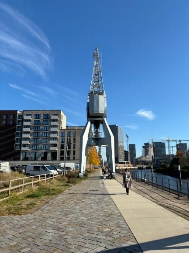
While walking through HafenCity, an old trade district that is being repopulated through a redevelopment in Hamburg, I noticed industrial cranes standing on the boulevard, unused but still playing a part in the surrounding environment. The visibility and history of this specific place stay noticeable. While cycling through Zwolle I noticed several local power transformer boxes, which are also structures in public space that can be found in every part of the city. Urban infrastructure like this makes me think about their potential, like how they could promote interactions between humans and non-humans. I fantasise about reusing neglected infrastructure in public spaces in a way that adds new roles to their functions and public identity. In my mind, I associate these common urban structures with plants — much like weeds, they are often underused, unwanted and overlooked, but noticeable and scattered throughout the city.
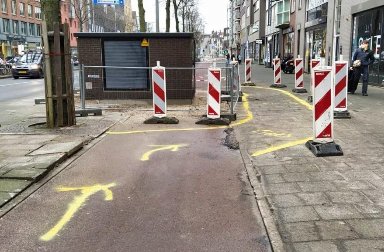

When I cycle to school, I interact with cars that pass me by, leaves on the road below me and other things I pass like bus stops or traffic lights as I move through public space. This makes me wonder about all the possible interactions between humans and non-humans that occur in public space.
At the International Architecture Biennale Rotterdam (IABR), in 2024, the IABR-Transition Atelier Jeux des Joules1, a design and research team, explored new strategies for local power transformer boxes, which sometime seem out of place in the urban environment.
Imagine cycling through Amsterdam and encountering a power transformer box on the road. The design and research team, The IABR-Transition Atelier, stated: “Public space is like a river. Everything inside it will be shaped by the constant flow of people, vehicles, materials and animals that runs through it.”2 Using a river to describe public space speaks to me because it implies that public space is always moving and dynamic. The IABR-Transition Atelier wondered, “Can we integrate other urban functions into these small buildings?”3Adding another importance to the role of power transformer boxes can lead to interaction between human and non-human actors.
The eco-philosopher and anthropologist, Bruno Latour, sees humans and non-humans; as actors and participants in a society who both have influence and make effect change. Non-humans – such as this laptop, my glasses or my desk chair- are not just passive objects; they play an active part in what I can and cannot do. Without the laptop, I wouldn’t be able to add this sentence between two others to exemplify the influence of non-humans – I would have to rewrite the text by hand. The rain might be the reason you take the bus instead of your bike. The speed bump on the road slows down the bus, which affects the time of arrival at the next bus stop without human interference. A laptop, glasses, a desk chair, the rain or a speed bump all make something possible, influence human actions.
You might say that the wheels of a car are all the same. Yet each wheel has a different influence on the balance and steerability of the car. Imagine a society without objects, artefacts or animals (non-humans). It leaves little besides us humans. So, the share of non-humans in networks must also be valued equally. Non-humans should not be seen as passive but as active.Imagine a classroom without students, or with students, but without tables and chairs. In both cases, there is a network of relationality. But the relationships between actors, in this casethe students, tables and chairs located in the classroom change. When there are no tables and chairs in the classroom, students might start occupying space differently, which might create different relationships between students and between the students and the classroom. Both students and tables have an influence on the classroom.
Networks between humans and non-humans also exist in public space: people feeding stale bread to ducks, in their local park; or imagine standing on the shore, but without any seagulls that usually fly rakishly over your head. Think of a bench near the train station that people often sit on to kill some time. These examples all describe a relationship between humans and non-humans in public space. But the share of non-humans in these cases is often not considered, let alone valued.
Sometimes I wonder, do we take the presence of non-humans in public space for granted? I have often thought about whether municipal infrastructures influence the relations between humans and non-humans. I am curious if and how a bench influences the ducks in a pond, or if an overflowing trash can address environmental issues in a neighbourhood.
I think of the world as a big web of elastics — the coronavirus radically shifted our sense of reality. Relationships soon appeared between the coronavirus and vaccines, facemasks, and apps on your phone. This could be understood through a concept like elasticity, elastics stretched between the increasing number of people working from home and changes in spatial organisation, in offices and public spaces. The relationships between them were dynamically shifting. Events like this support Bruno Latour’s theory. Bruno Latour uses Actor-network theory to encourage ecological thinking, by recognising and promoting interwovenness. Like people, objects, artefacts, animals, plants and weather influences also play a part in social problems. You cannot separate the nitrogen crisis from the climate crisis, the agricultural sector, for instance, or the factories emitting a lot of carbon-dioxide. There are many more connections, not only manure or the cars we drive.
Rob Roggema4, professor of Regenerative Culture writes about how urban landscapes can be designed more ecologically: “The Eco-cathedric City builds on the self-organizing power that is common in nature. This fundamental new way of urbanization applies power to three factors: the time perspective of urban change (eco-time), the way the city is designed (eco-space), and how decision making occurs (eco-cracy).”5 These three factors offer a different perspective on how to build cities that are not just about humans. Because humans are not the only participants in the city or ecosystems around us.
Oppositional Relationships: Humans and Non-Humans in Public Space
Treating non-humans as non-participants has greatly affected how designers approach the world. The current separation between humans and non-humans is unjust to both parties,including endangered species, melting icebergs, and people who lose their homes due to natural disasters. The climate crisis and the nitrogen crisis affect both humans and non-humans. The word crisis understates the seriousness of the current situation, especially when we consider the impact of humanity on the earth. We know a crisis to be temporary, something that will pass.
But global warming, rising water levels and worrying CO2 levels are irreversible. The Parliament of Things6 by Bruno Latour makes a case for the rights and voices of non-humans, like animals and objects. With this paper, I align myself with this aspiration, to give a voice to the non-humans in the public space, which we see, meet and use on a daily basis.